
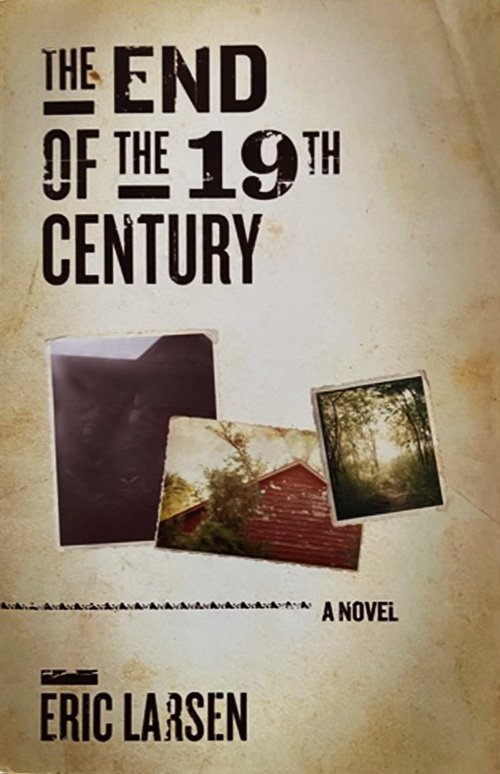
THE END OF THE 19th CENTURY (2013)
The novel is a prequel to An American Memory and I Am Zoë Handke. Again, it concerns the life of Malcolm Reiner, this time as drawn from tales of his distant forebears and from his own earliest memories, It moves then through his later childhood and adolescence, touching on his adulthood. The novel chronicles, in this order, “The History of West Tree,” “The End of the Epoch of Walking,” and “The Disappearance of Everything,” the last of these including the disappearance itself of Malcolm’s home town of West Tree, Minnesota. The historical time covered by the book is a span approximately from 1853 to 2010.
Note: The End of the 19th Century was completed by 1997, but as a result of the sea-change that had taken place in American culture throughout the 1990’s, it found no publisher until years later (in 2011) with a new and tiny organization where, lacking visibility, the book went unreviewed. It did, however, sometimes receive praise in the process of being rejected.
• •. •. •. •
“The End of the Nineteenth Century overflows with deep, haunting compassion.
--Jonathan Safran Foer, 2004
“Like I Am Zoë Handke (1992), it has all the fundamental characteristics that draw me into a book of fiction. I was completely in its universe when I was reading it; I wanted to return to that universe when I was not reading it; and the universe generated by the work lingered and haunted my seeing after I completed reading it.”
—Gregory Marszal, poet, author of The Chromosomes of Summer, The Book of Transparencies, and Catalogue of Being
“[Larsen] is a brilliant writer. . . . If I were a one-person publisher (with a big enough subsidy not to have to worry about things like chain stores), I would put it into print almost exactly as it stands. [It] is like an irresistible tunnel down which [the writer] has disappeared, and for this reader, at least, the temptation to follow him is strong. [It] is a book comparable with poetry.”
—Shannon Ravenel, Algonquin Books of Chapel Hill
”The writing here is simply stunning. What this novel chronicles is the complete loss of the American agrarian past and with it all sense of rootedness and connectedness. It is an important, if apocalyptic, work, its writer gifted with genius. Please don’t let it go.”
—Jane Vandenberg, author of Failure to Zigzag and A Pocket History of Sex in the Twentieth Century
”It does not happen to me very often that I find it necessary to reject work that I admire greatly. Not only am I full of admiration for this book, but its first reader here wrote one of the most extraordinary reader’s reports I’ve ever received. . . . I believe this book is a profound act of memory, a sort of American Proust. I was mesmerized in reading. I can only hope you will find a publisher who will have great success in publishing this book and will vindicate my own enthusiasm and prove all the others here dead wrong.”
—Jack Shoemaker, Editor, Counterpoint Press
”Boy, I really like this novel. I like the way you write. I like the structure. I like the fashion in which you parcel out the story. I like the subject. You’ve really done a wonderful job and the book deserves to be published.”
—Letter from Kathryn Belden, Four Walls Eight Windows
“Publishing has gone to the dogs.”
—Note from Kathryn Belden, Four Walls Eight Windows
Reviews and Praise
-
A HISTORY OF A TOWN THAT DISAPPEARED |. THE END OF EVERYTHING
THE END OF THE 19TH CENTURY
Or it might be called Maps of a Vanished Past.
I’ve asked John McLeod if he can, via Algonquin, lay hands on the two previous parts to this larger work. The writing here is simply stunning, rendering in a detail that seems super-realistic the entire history of West Tree, a farming town that was born beside a river early in the 1800s, was home to a railroad, by which the narrator’s relatives came, lived and worked, taught college, prospered for a time, then fell—as a result of the End of the Epoch of Walking (when, presumably, via our dependence on the car, the Context of No Context was introduced into the warp and weave of the American fabric)—into darkness, anomie, despair.
What this novel chronicles is the complete loss of the American agrarian past and with it all sense of rootedness and connectedness. If one were to do this book, as I fervently believe you should, it might be sold to the readers of Wendell, Don Haringon, Wes Jackson, Terry Tempest Williams, so forth, and I think it would be little trouble to get their support for this project, as it is an important, if apocalyptic, work.
There is, however, nothing homespun about this novel: its literary precursors would have to be Joyce, Becket, Proust. It is deeply modernist, in that it is experimental in form, including “maps” of all levels of detail (these, I believe, would have to be redrawn as they’re clumsily done right on computer or graph paper now) but deftly show the complete vision to which this writer is committed.
The maps might be redrawn by someone with an artistic vision and skill on the same level as the writer’s, that is, someone like Louise Diederick, who might do work as an illustrator, using pen and ink so the reproduction would remain cost effective. (She, or someone, might do this, I think, as part of a royalty arrangement.)
The three-dimensional detail, the carefully witnessing by the Coming of Age narrator (born in 1940 or so) during what he calls his Era of Perfect Seeing (during which he is witness to a perfect harmony and balance of Time/Space, Near/Far, Family/Society, Self/Earth/Universe) culminating in a specific morning when he comes upon his father who is smoking al cigarette while naked on the front lawn of the hillside farm sitting in a painted white lawn chair as he surveys the fields and river and town. The boy, who is never named, then steps forward in front of his father and is able, therefore, to see farther than the father can, that is into the future that will witness not only the destruction of all members of this family but an entire way of life.
This book is important, its writer gifted with genius. Please don’t let it go.
Jane
P.S. The title seems modest to me. The End to the Era of Walking, or The Time of Perfect Seeing, for instance, both seem somehow large to me as titles and might sit more squarely over the author’s themes.
-
Eric Larsen's third novel is marvelous. I don't know how I can say it more simply: I love the book. Like I Am Zoë Handke (1992), it has all the fundamental characteristics that draw me into a book of fiction. I was completely in its universe when I was reading it; I wanted to return to that universe when I was not reading it; and the universe generated by the work lingered and haunted my seeing after I completed reading it.
Again, what struck me first was the writer's profound mix of clarity with poetic evocation. How does Larsen do that? I assume that it is not only a matter of art, or technique, but that it is the expression of an existential accomplishment, or a way of life.
As I moved through the events of the book, there was never any doubt that I was inside reality; that the materiality of things--their densities and their textures--was always present, but at the same time the question of their ultimate values, or of their potential significance, reverberated with depth and possibility. Isn't this the opposite of the hubris found in the bland "realism" we drown in today? That conventional kind of realism believes that somehow it has arrived at the very origin of things, at the one true and fundamental reality of what is. There are many reasons for this, and I'm sure that Eric Larsen is aware of all of them. I'm sure also that he is more intensely aware than most people of how we live now in a world aesthetically both alienating and void--so much so that language itself is drained of its potential for seeking depth, newness, or originality either in thought or emotion. All the "market-driven" oceans of work put out by publishers prides itself that by means of its unquestioning "realism," it has arrived at the very origin of things, at (as I said before) the one true and fundamental reality of what is. This smug attitude is so pervasive, so deeply entrenched, as to have grown nearly totalitarian in its omnipresence and fake authority.
One of the essential things that I have learned in my own efforts as a writer of poetry is that the poetic consciousness is generative of value. And that's why Larsen's books live the way they do. He doesn't appeal to any transcendent, any other-worldly value system, to underpin his own purposes, values, or aims. The boy in The End of the 19th Century experiences the very genesis of meanings, not the imposing of them. In Larsen, as in other writers who knew this same truth about the relation between writing and existing--writers as seemingly unalike as Whitman and Joyce--you become aware, as does the character in Larsen's novel, that Being is infinite, and, as such, is capable of being refracted and viewed from innumerable points, and is even then not fully known.
Furthermore, each of these points isn't simply a geometric location in time and space, but each one is a potential alpha point for new meanings and new revelations.
In a word, what attracts me to Larsen's writing is his use of what I call "the ontological imagination." Of course, in our age of simple polarities, some will say this makes his work irrational or anti-scientific. I have had such accusations directed at me far too often by readers of my own poetry.
If you assert that the Real may be just a bit more possible and dynamic than what the age of literalism says it is, you'll likely be taken as deluded, irrational, anti-scientific, or even worse, mystical. But as this hyper-conventionalized single reality--the false, narrow, obedient, and "understandable" one--becomes ever more dominate and ever more embedded in our economic, cultural, and metaphorical life, the more difficult it becomes for the ontological imagination to survive, let alone be valued. Simply put, I understand the history and evolution of human consciousness as the imaginative function in a dynamic and creative interplay with the brute facts of reality: And these brute facts are death, time, hunger, body. And these same brute facts, no matter how light and unassuming one of Larsen's scenes or passages might be on the surface, are never absent in his work or in his consciousness as he works.
Malcolm Reiner, the boy and central figure in The End of the 19th Century, is more incarnated than Zoë, in I Am Zoë Handke, was. For all her virtues, Zoë was a more ethereal, disembodied creature, more of a pure consciousness. I don't remember her ever meditating on her femininity or her sexuality. She never seemed to encounter her biological life in the way the boy--and her future husband--does.
The young Malcolm, however, during his most explicitly detailed sexual awaking, struggles to incorporate this new-found energy into his main project, the saving of history itself. His desire, toward the end of the book, to save time itself, to stave off the disintegration of his universe, and to return to the wholeness of his "years of perfect seeing" is extraordinarily moving.
Some may say that this is a nostalgic vision. I don't think so. The boy is at war on two fronts. He is experiencing the inevitable and essential coming of age personally, where loss and pain are unavoidable. We look back, and if we don't give in to despair, we attempt to recover what we can and incorporate these truths and energies into our present life. If they are traumatic, we attempt to exorcise them; if they are moments of beauty and generative of goodness, we remember and we love. And if that love becomes generative of action and Being in the present, its meaning duplicates itself. Meaning is built upon meaning like coral.
But, alas, Malcolm is, instead, experiencing a cosmic death. "The End of the Age of Walking"--isn't that what the phrase must mean, at least in part? Something much larger is occurring beyond one child's growth into self awareness. He is experiencing--and if this sounds strong, let it so be--an apocalypse.
Forces are at work that are changing the very foundation of a person's ability to experience meaning. The acceleration of time and the abstraction of space as embodied, for example, in the highway that cuts right through West Tree, are the vanguard of a new and monstrous modernity. The disappearance of West Tree itself is not simply personal death, but it is a cosmic one, the end of an age. The end of an age: Can we even begin to grasp what that means?
As a poet who works in short forms, the broader structure of entire novels is not my natural strength, but I had no problems with structure here. As opposed to I Am Zoë Handke, nothing is in excess, and nothing seemed to be abbreviated--whereas Part V, to my mind, in Zoë was mildly, or arguably, extra. In The End of the 19th Century the weavings, the departures, the returns, all of them make perfect sense, vanishing in a fine clean cloth of sound, image, and sense.
Of course I wonder about the future for a book like this. I wish that anything might be possible. There must still remain large numbers of people capable of being--and eager to be--excited and inspired by this kind of rare, wonderful, essential--and essentially truth-revealing--literary virtues. How to find and reach those readers, I don't know. I myself am lucky to have found the book. I pray that the book may be so lucky as to find many others to read it.